Überblick
Datentransformation ist der Prozess, Daten von einem Format, einer Struktur oder einem Schema in ein anderes umzuwandeln – Rohdaten zu bereinigen, zu standardisieren, zu aggregieren und in eine konsistente, hochpräzise Form abzubilden, der nachgelagerte Analyse-, Business Intelligence- (BI) und Künstliche Intelligenz (KI)-Modelle vertrauen können.
In modernen Unternehmensumgebungen gelangen Rohdaten aus fragmentierten Systemen in unterschiedlichen Strukturen: unstrukturierte Betriebsprotokolle, Transaktionsdatensätze, IoT-Sensor-Telemetrie und semi-strukturierte JSON-Nutzlasten. Unverfeinert schaffen diese unterschiedlichen Ströme Datensilos, zerstören nachgelagerte analytische Pipelines und bringen Verzerrungen in maschinelle Lernsysteme ein. Umfragedaten zeigen, dass Data-Engineering-Teams routinemäßig bis zu 80 % ihrer Betriebszyklen der manuellen Datenvorbereitung und -transformation widmen, anstatt der hochwertigen Modellierung.
Durch die Einrichtung automatisierter, skalierbarer Datentransformationspipelines heben Organisationen rohe, multiquellenbasierte Eingaben in unternehmensweite Datenressourcen auf. Diese sauberen, strukturierten Assets treiben Echtzeit-Dashboards, prädiktive Algorithmen, Feature Engineering für generative KI und regulatorische Berichterstattung an. Als führender Kandidat in The Forrester Wave™: Data Management for Analytics Platforms, Q2 2025 anerkannt – mit der höchstmöglichen Punktzahl (5/5) in Data Transformation, Data Integration und In-Platform Analytics – bietet die Teradata-Plattform die Hochleistungsgrundlage, die erforderlich ist, um komplexe Transformations-Workloads im großen Maßstab mit den Standardanalysefunktionen der Teradata-Datenbank zu verarbeiten.
Wichtige Erkenntnisse
- Datentransformation standardisiert und strukturiert Rohdaten zu einem einheitlichen, hochwertigen Asset für Analyse-, BI- und Machine-Learning-Modelle.
- Die grundlegende Pipeline folgt fünf Hauptschritten: Sammlung, Reinigung, Normalisierung, Aggregation und Mapping.
- Moderne Cloud-Architekturen bevorzugen zunehmend ELT (Extract, Load, Transform) und nutzen enorme Rechenleistung in der Datenbank, um Daten direkt innerhalb der Teradata Cloud zu transformieren.
- Flexible Werkzeuge reichen von Open-Source-Sprachen (Python, R, SQL) über dedizierte ELT-Frameworks (wie Teradata auf dbt Cloud) bis hin zu nativen Datenbankfunktionen in der Teradata-Datenbank.
- Wirkungsvolle Transformationen treiben kritische Arbeitsabläufe in den Bereichen Finanzcompliance, Gesundheitsinteroperabilität, Kundenanalysen im Einzelhandel und Executive BI an.
Datentransformationsprozess
Der Datentransformationsprozess umfasst mehrere koordinierte Aufgaben, die rohe, unverfeinerte Daten in eine strukturierte und hochzuverlässige Ressource umwandeln. Während einzelne Implementierungen von der Unternehmensarchitektur und Geschäftszielen abhängen, folgen die meisten Hochleistungs-Transformationsworkflows einem Kernsatz von Schritten der Datentransformation. Jeder Schritt läuft innerhalb einer breiteren Datenpipeline , die Datensätze vom Quellsystem zum analytischen Ziel transportiert.
1. Datenerhebung
Rohdaten werden aus Quellumgebungen extrahiert – darunter CRM-Datenbanken, ERP-Systeme, Web-APIs, Cloud-Speicher und Streaming-Plattformen. Da diese Eingaben in heterogenen Formaten (SQL-Tabellen, CSVs, JSON, XML) ankommen, stellt die Erstsammlung die Basisverbindung für die Downstream-Verarbeitung her. Die Konsolidierung heterogener Quellen auf diese Weise macht eine downstream-Transformation innerhalb der Plattform im Unternehmensmaßstab möglich.
2. Datenreinigung
Die Reinigung behebt strukturelles Rauschen und Fehler in Rohdatensätzen. In dieser Phase identifizieren und beheben automatisierte Regeln unvollständige Felder, eliminieren doppelte Datensätze, gleichen widersprüchliche Werte ab und behandeln fehlende Daten. Um zu erfahren, wie automatisierte Reinigungs- und Validierungsprotokolle die Zuverlässigkeit von Pipelines sichern, lesen Sie unseren ausführlichen Leitfaden darüber , was Datenbereinigung ist.
3. Datennormalisierung
Die Normalisierung standardisiert Datenwerte über verschiedene Systeme hinweg, sodass sie genau verglichen und verknüpft werden können. Gängige Methoden umfassen das Umformatieren von Zeitstempeln auf ISO-Standards, die Umrechnung von Währungswerten, das Skalieren numerischer Bereiche für maschinelles Lernen (z. B. Min-Max-Skalierung oder Z-Score-Normalisierung) sowie die Ausrichtung von Codedefinitionen (z. B. Abbildung von "US", "USA" und "United States" auf einen einzigen Standard).
4. Datenaggregation
Die Aggregation synthetisiert granulare Datensätze auf Datensatzebene zu zusammenfassenden Statistiken, die für Berichte und Executive Dashboards angepasst sind. Zu den Abläufen gehören die Berechnung der täglichen Umsatzsummen, das Durchschnitt der Kundenantwortzeiten nach Region oder die Berechnung von rollierenden 30-Tage-Transaktionsvolumen.
5. Datenabbildung
Data Mapping definiert die genauen Feldbeziehungen zwischen Quellschema-Attributen und Ziel-Datenbank-Zielen. Mapping legt den Bauplan fest, der sicherstellt, dass Datenfelder während komplexer Systemintegrationen oder Datenmigrationsprojekte zu ihren exakt entsprechenden Zielen geführt werden.
Zusammenfassung der Datentransformationsmethoden
Um die richtigen Datentransformationsmethoden für Ihre Pipeline auszuwählen, vergleichen Sie unten deren Kernfunktion, primären Anwendungsfall und operative Komplexität.
| Transformationsmethode | Was es bewirkt | Wann man es einsetzen sollte | Beispiel | Komplexität |
|---|---|---|---|---|
| Datenreinigung | Entfernt Fehler, Duplikate und ungültige Datensätze | Vor dem Laden oder Analysieren nicht vertrauenswürdiger Rohdaten | Korrektur von falsch geschriebenen Adressen und Löschen doppelter Kunden-IDs | Niedrig–mittel |
| Datennormalisierung | Standardisiert Formate, Bereiche und metrische Skalen | Vorbereitung von Funktionssätzen für Datenbanken, BI oder KI-Modelle | Standardisierung von Datumsformaten auf JJJJ-MM-DD oder Skalierung von Werten zwischen 0 und 1 | Medium |
| Datenaggregation | Fasst feingranulare Aufzeichnungen in Geschäftskennzahlen zusammen | Erstellung von Executive Dashboards, KPIs und Berichtsebenen | Summierung stündlicher Ladentransaktionen in wöchentliche regionale Umsatzzahlen | Niedrig |
| Datenmapping | Verbindet Quellfelder mit Zielschema-Attributen | Systemintegration, Schema-Konsolidierung und Migrationen | Übereinstimmung von cust_num im CRM mit Account_ID im ERP | Medium |
| Datenanreicherung | Fügen externe oder kontextuelle Datenpunkte hinzu | Verbesserung der analytischen Tiefe und Kundensegmentierung | Hinzufügen demografischer oder geolokalisierter Attribute zu Benutzerprofilen | Mittel–hoch |
In Produktionsumgebungen kombinieren Ingenieurteams diese Methoden häufig in breitere Daten-Workflow-Orchestrierungsmodelle, um die kontinuierliche Pipeline-Integrität zu gewährleisten.
Datentransformationen in ETL und ELT
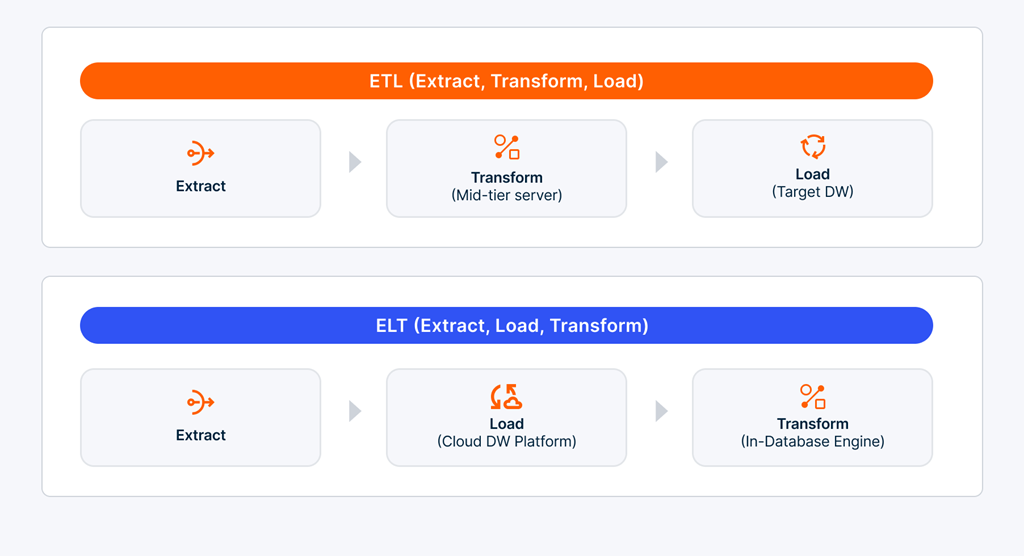
Datentransformation ist ein Kernelement sowohl in der Datenextraktion, -transformation und -lade-(ETL-) - als auch in der Extract, Load-and-Transform-(ELT)-Architektur – den grundlegenden Mustern der modernen Datenintegration.
Der traditionelle ETL-Ansatz
In klassischen ETL-Pipelines findet die Datentransformation auf einem zwischenliegenden Staging-Server nach der Extraktion aus den Quellsystemen statt, jedoch vor dem Laden in das Ziel-Datawarehouse.
- Stärken: Gewährleistet strenge Datenqualität, Governance und Compliance-Formatierung, bevor die Rohdaten dauerhaft gespeichert werden.
- Am besten verwendet für: Altgestützte On-Premises-Architekturen, sensible Datensätze, die eine strenge Pre-Load-Anonymisierung erfordern, und starre Compliance-Frameworks.
Der moderne ELT-Ansatz
Mit der Entwicklung der Cloud-Datenplattformen hat sich ELT als dominierende Architektur für Unternehmensanalysen und KI-Feature-Vorbereitung etabliert. In ELT-Pipelines werden Rohdaten extrahiert und sofort im ursprünglichen Format in das Cloud-Datawarehouse geladen. Transformationen werden dann direkt innerhalb der Datenplattform mit nativer, parallelisierter Rechenleistung durchgeführt.
- Stärken: Bietet enorme Leistungsskalierbarkeit, schnellere Ladezeiten und flexible Schema-on-Read-Funktionen für semistrukturierte Daten.
- Am besten verwendet für: Cloud-Analysen mit hohem Volumen, unstrukturierte/semistrukturierte Datenströme, Echtzeitanalysen und fortgeschrittene KI/ML-Feature-Engineering.
Ob man sich für ETL oder ELT entscheidet, hängt vom Datenvolumen, den Anforderungen der Pipeline-Latenz und der Infrastruktur ab. Organisationen, die komplexe Unternehmens-Workflows verwalten, setzen häufig Ende-zu-End- Datenorchestrierung ein, um hybride ETL/ELT-Aufgaben nahtlos über verteilte Cloud-Netzwerke hinweg zu koordinieren.
Beispiel für Datentransformation
Um die Datentransformation in der Praxis zu verstehen, sollten Sie einen regionalen Gesundheitsdienstleister betrachten, der Patientenkennzahlen über verschiedene Kliniken, Diagnostiklabore und elektronische Gesundheitsaktensoftware (EHR) integriert.
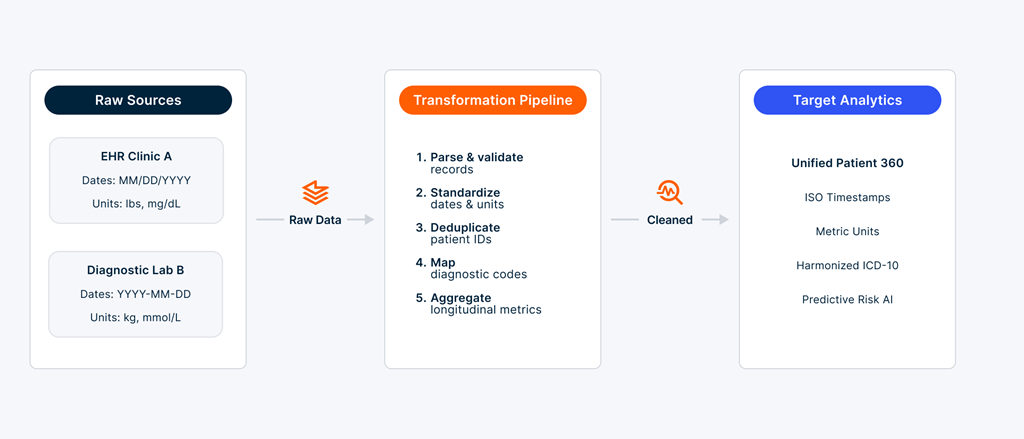
- Extraktion: Rohtabellen werden aus Klinik A extrahiert (unter Verwendung imperialer Messeinheiten und MM/DD/JJJJ-Daten) und aus Labor B (mit metrischen Einheiten und JJJJ-MM-DD-Daten).
- Reinigung und Validierung: Sensorwerte außerhalb des Bereichs (z. B. negative Pulswerte) werden markiert und an Ausnahmewarteschlangen weitergeleitet, während doppelte Patienteneinträge zusammengeführt werden.
- Normalisierung: Alle Gewichtswerte werden in Kilogramm (kg) umgerechnet, Blutzuckermessungen auf mg/dL standardisiert und Zeitstempel stimmen ISO 8601 entsprechen.
- Abbildung und Aggregation: Diagnosecodes werden auf universelle ICD-10-Klassifikationen abgebildet, und einzelne klinische Besuche werden zu einem einzigen longitudinalen Patientenprofil zusammengefasst.
Das Ergebnis bietet Klinikern und Data Scientists eine klare, einheitliche Sicht auf die Gesundheit der Patienten und ermöglicht direkt prädiktive Analysen für frühe Krankheitsinterventionen und generative KI-klinische Assistenten.
Best Practices für Datentransformation
- Legen Sie klare Geschäftsziele fest: Definieren Sie Anforderungen des Endnutzers vor der Entwurf von Schemata, um unnötigen Rechenaufwand zu vermeiden.
- Setzen Sie die Datenverwaltung frühzeitig durch: Halten Sie strenge Datenqualitätskontrollen, Audit-Protokolle und Linienverfolgung während des gesamten Transformationslebenszyklus aufrecht.
- Integrieren Sie automatisierte Tests: Implementieren Sie automatisierte Unit-Tests und Schema-Überprüfungen innerhalb der Transformationspipeline, um Anomalien zu erkennen, bevor sie in die Produktionsberichte gelangen.
- Nutzen Sie die Verarbeitung in der Datenbank: Minimieren Sie kostspielige Datenbewegungen, indem Sie Transformationen direkt innerhalb skalierbarer Cloud-Datenplattformen durchführen.
Vorteile der Datentransformation
Eine robuste Datentransformationsstrategie liefert grundlegende Vorteile, die jede Ebene eines unternehmensweiten Datenökosystems betreffen.
Verbesserte Datenqualität und Konsistenz
Rohdaten enthalten von Natur aus Fehler, redundante Felder und nicht übereinstimmende Formate. Systematische Bereinigung und Normalisierung beseitigen diese Anomalien und gewährleisten konsistente, hochpräzise Eingaben über Geschäftsbereiche hinweg. Hochwertige Daten verringern operative Reibungen, verringern das Compliance-Risiko und schaffen eine einzige Wahrheitsquelle.
Erweiterte Datenanalyse und Entscheidungsfindung
Transformierte Daten ermöglichen es Data Scientists und Business Analysten, fortschrittliche Analysemodelle ohne manuelle Vorbereitung anzuwenden. Saubere, strukturierte Datensätze verbessern direkt die Leistung von prädiktiven Algorithmen, Executive Dashboards und statistischen Modellen. Zum Beispiel vereinfacht die Anwendung normalisierter Kennzahlen die nachgelagerten Berechnungen in deskriptiver Statistik und automatisierter Berichterstattung.
Erhöhte operative Effizienz
Die Automatisierung der Datentransformation eliminiert manuelle Datenwrangling-Bemühungen, die bis zu 80 % der Zeit eines Analyseteams in Anspruch nehmen. Standardisierte, automatisierte Pipelines beschleunigen die Bereitstellung von Insights, senken die Verarbeitungskosten und verbessern die Leistung von Anwendungsabfragen in Unternehmenssystemen.
Datentransformationswerkzeuge
Die Wahl der richtigen Software hängt vom Datenvolumen, der Architektur, den Fähigkeiten und der Ausführung der Transformationen ab – von Entwickler-Codeskripten bis hin zu Enterprise-Cloud-Plattformen.
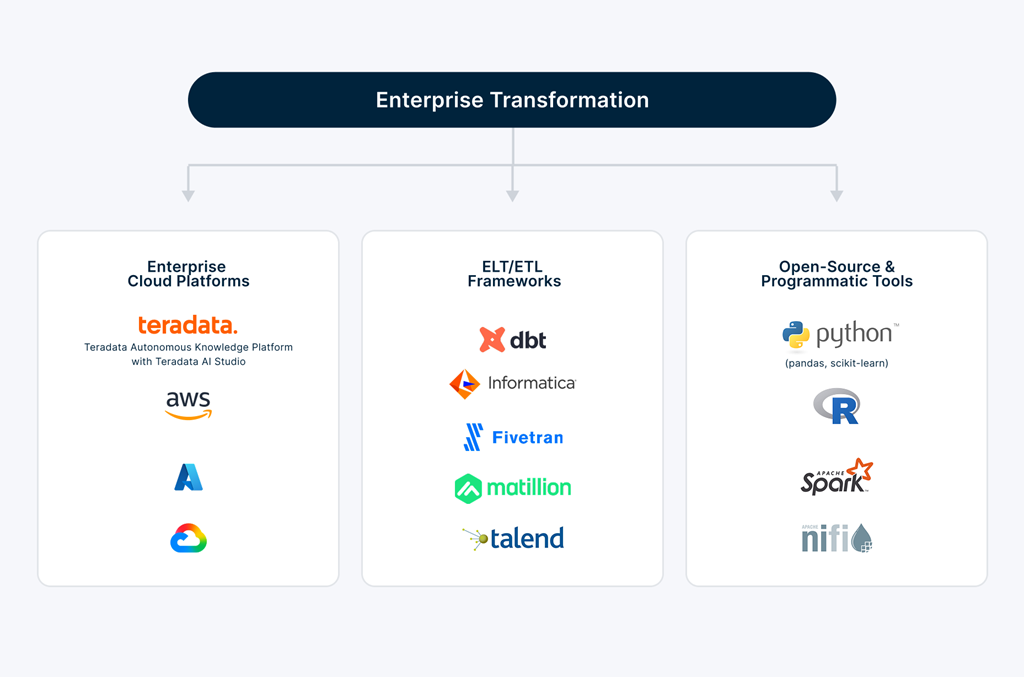
Teradata Cloud und In-Database Analytics mit Teradata Database
Moderne Unternehmensarchitekturen priorisieren die Ausführung von Transformationen direkt innerhalb der Datenspeicherschicht, um Latenz und Datenausgangskosten zu vermeiden.
- Cloud: Als verwaltete Cloud-Bereitstellungsumgebung führt Teradata Cloud massiv ELT-Transformationen nativ aus. Database bietet parallelisierte In-Database-Funktionen für Datenvorbereitung, Feature Engineering, Textanalyse und Vektorgenerierung – komplexe Transformationen werden direkt dort durchgeführt, wo sich Daten befinden, ohne externe Extraktion.
- Ökosysteme für Cloud-Infrastruktur: Führende Cloud-Datenplattformen – darunter Teradata Cloud, Snowflake, Google BigQuery, Databricks und AWS Redshift – nutzen Datenbank-Computing, um hochdurchsatzfähige ELT-Pipelines effizient zu verarbeiten.
Spezialisierte ETL- und ELT-Frameworks
- DBT (Data Build Tool): Ermöglicht es Datenteams, Transformationen als modulare SQL-Abfragen zu schreiben, was moderne Analyse-Engineering-Praktiken unterstützt. Mit Integrationen wie Teradata in dbt Cloud können Teams versionskontrollierte Transformationsmodelle mit unternehmensbasierter Governance verwalten.
- Informatica, Fivetran, Matillion & Talend: Bereitstellen vorgefertigte Connectoren und automatisierte visuelle Schnittstellen, um komplexe Datenaufnahme- und Transformationspipelines über Multi-Cloud-Topologien hinweg zu orchestrieren.
Open-Source- und programmatische Frameworks
- Python und R: Bieten granulare Steuerung für benutzerdefinierte Transformationsaufgaben. Python-Bibliotheken wie pandas und scikit-learn bieten robuste Funktionen (z. B. MinMaxScaler, StandardScaler) für die Feature-Engineering, während R in der statistischen Manipulation hervorragend ist.
- Apache Spark und Apache NiFi: Bieten verteilte Rechenleistung für Big-Data-Transformationen, Streaming-Telemetrie und Hochgeschwindigkeits-Ereignispipelines.
Anwendungsfälle in der Branche
Die Datentransformation bildet das Rückgrat für branchenspezifische Datenaktivierung.
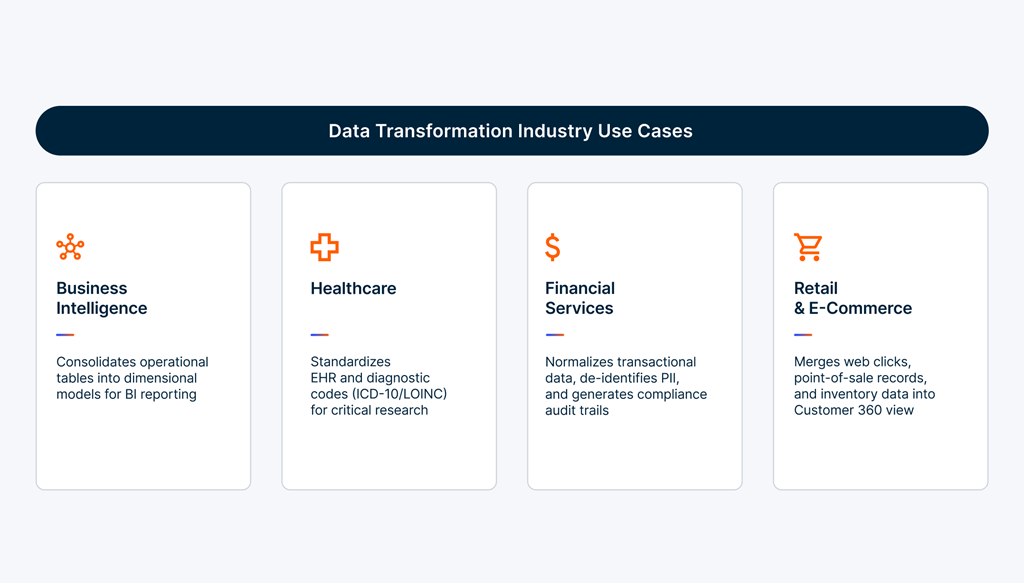
- Business Intelligence: Rohbetriebliche Betriebsprotokolle werden bereinigt, aggregiert und in Star-Schema-Datenspeicher abgebildet, was der Führung genaue, Echtzeit-Einblicke in Unternehmens-KPIs liefert.
- Gesundheitswesen und Lebenswissenschaften: Medizinische Unterlagen, Laborergebnisse und Abrechnungsdateien von unterschiedlichen EHR-Anbietern werden in standardisierte Formate (wie FHIR) umgewandelt, was eine nahtlose klinische Interoperabilität und Patientenergebnisverfolgung ermöglicht.
- Finanzdienstleistungen: Finanzinstitute transformieren Rohtransaktionsströme, um betrügerische Aktivitäten in Echtzeit zu erkennen, grenzüberschreitende Währungsumrechnungen zu normalisieren und automatisierte Regulierungsberichte zu erstellen.
- Einzelhandel und E-Commerce: Einzelhändler kombinieren Online-Browsing-Sitzungen, Point-of-Sale-Transaktionen und Aktualisierungen der Lieferkette zu einheitlichen Kundenprofilen, um personalisierte Empfehlungsmaschinen und dynamische Bestandsprognosen zu ermöglichen.
Fazit
Die Datentransformation verwandelt rohe, fragmentierte Daten in ein strukturiertes, zuverlässiges Asset – das bildet die grundlegende Grundlage für moderne Business Intelligence, Unternehmensanalysen und KI. Da das Datenvolumen von Unternehmen in Multi-Cloud-Umgebungen weiter zunimmt, ist die effiziente und sichere Durchführung von Transformationen im großen Maßstab zu einem entscheidenden strategischen Vorteil geworden.
Durch die Nutzung der in-database-Funktionen der Teradata Database innerhalb der Teradata Cloud können Organisationen Daten direkt an ihrem Standort transformieren – wodurch redundante Datenbewegungen eliminiert werden, die Leistung der Pipelines beschleunigt und die betriebliche Komplexität reduziert wird. Um zu erkunden, wie Sie Ihre Datenpipeline-Architektur transformieren oder die Expertise Ihres Teams vertiefen können, besuchen Sie die In-Database Analytics-Ressourcen von Teradata oder sehen Sie sich Lernpfade an der Teradata University an.
Bereit, Ihre Enterprise-Transformations-Workloads zu modernisieren?
Hören Sie auf, bis zu 80 % Ihrer Daten-Engineering-Bandbreite für manuelles Wrangling und teure externe Staging-Hardware auszugeben. Modernisieren Sie Ihre ELT-Pipelines direkt in der Datenbankschicht, um massive parallele Verarbeitung freizuschalten, Cloud-Computing-Overhead zu reduzieren und KI-taugliche Datensätze in Echtzeit bereitzustellen.
Entdecken Sie Teradata In-Database Analytics Lösungen oder vereinbaren Sie eine Architektur-Demo , um zu sehen, wie die Teradata-Plattform hochvolumige Rohstreams in Enterprise-Intelligence in großem Maßstab umwandelt.
Häufig gestellte Fragen
Was sind die Hauptarten von Datentransformationen?
Was sind die Hauptarten von Datentransformationen?
Die Hauptarten der Datentransformation umfassen:
- Konstruktive Transformation: Erstellt neue Metriken, berechnete Felder oder aggregierte Attribute aus bestehenden Daten.
- Destruktive Transformation: Eliminiert unnötige Felder, redundante Datensätze oder sensible Werte (z. B. das Entfernen von rohen personenbezogenen Daten während der Compliance-Filterung).
- Ästhetische Transformation: Standardisiert Datenformate, wie zum Beispiel das Umformatieren von Telefonnummern, Daten oder Adresszeichenfolgen.
- Strukturelle Transformation: Reorganisiert Datenbankschema-Topologien, wie zum Beispiel das Pivotieren von Zeilen in Spalten oder das Abflachen hierarchischer JSON-Dokumente in relationale Tabellen.
Welche Risiken sind mit der Datentransformation verbunden?
Welche Risiken sind mit der Datentransformation verbunden?
Wichtige Risiken in Datentransformationspipelines umfassen:
- Datenverlust oder -korruption: Fehlerhafte Zuordnungsregeln oder falsche Datenabschneidung während der Transformation können kritische Datensätze überschreiben.
- Leistungsengpässe: Das Ausführen komplexer, nicht optimierter Transformationsskripte auf riesigen Datensätzen kann nachgelagerte Pipelines blockieren und Cloud-Rechenleistungen in die Höhe treiben.
- Sicherheits- und Compliance-Versäumnisse: Das unbeabsichtigte Offenlegen sensibler Datensätze oder das Versäumnis, die erforderlichen Maskierungsfunktionen während der Verarbeitung anzuwenden, führt zu Governance-Schwachstellen.
- Schema-Drift: Unangekündigte Änderungen der vorgelagerten Quellformate können Transformationsskripte zerstören und Zieltabellen beschädigen.
Wo sollte man bei der Datentransformation anfangen?
Wo sollte man bei der Datentransformation anfangen?
Um einen effektiven Datentransformationsprozess zu etablieren, folgen Sie diesen grundlegenden Schritten:
- Entdeckung und Profilierung: Analysieren Sie Ihre Rohdatenquellen, um Schemavariationen, Qualitätsfehler und fehlende Werte zu identifizieren.
- Abbildung und Regeldefinition: Definieren Sie Geschäftsregeln, Feldabbildungen und Transformationslogik, bevor Sie Code schreiben.
- Datenbereinigung und Vorverarbeitung: Reinigen Sie Rohdatensätze, indem Sie Duplikate beheben, Datentypen standardisieren und Formate mit Tools wie Datenbereinigung validieren.
- Ausführung und Orchestrierung: Laden und transformieren Sie Daten mithilfe skalierbarer Architekturen (wie ELT in Teradata Cloud), die durch zuverlässige Workflow-Orchestrierung verwaltet werden.
- Kontinuierliche Überwachung: Implementieren Sie automatisierte Pipeline-Überwachung, um Schema-Driften zu verfolgen, die Ausgabegenauigkeit zu validieren und die langfristige Datenqualität zu gewährleisten.