
As Teradata’s chief product officer, I meet customers investing aggressively in AI—yet struggling to turn that spend into repeatable outcomes. The constraint isn’t data volume; it’s activated knowledge: trusted context, governed semantics, and operational pathways that let AI move from answering questions to taking action.
Many enterprises are struggling with these three questions:
- Can your AI platform deliver enterprise-grade outcomes with velocity?
- Does your AI run where your data and knowledge live?
- Are you locked into single-vendor usage pricing, limiting control over cost and risk?
Introducing the Autonomous Knowledge Platform
The Autonomous Knowledge Platform unifies data management, analytics, AI, agentic execution, governance, and autonomous optimization—so organizations can move from isolated insights to continuously operating, trusted outcomes.
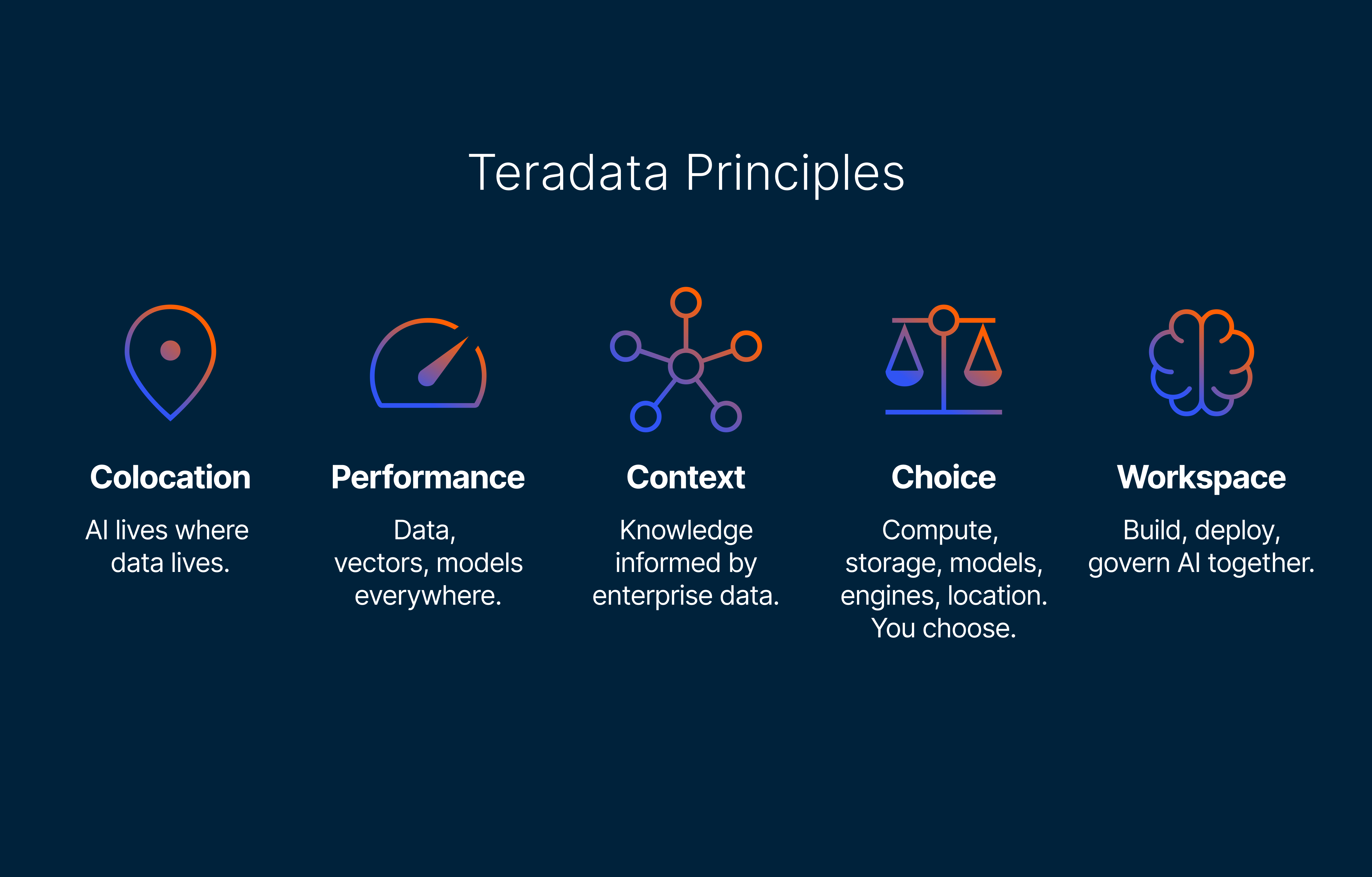
The platform is built around five core principles:
- Colocation: Data and compute have always been together at Teradata. AI and data are now colocated. Same principle, new era.
- Performance: Performance equals economics. Data, vectors, and models run where they best meet your needs, with location independence at every layer.
- Context: Extensive industry knowledge models put us in a unique position to deliver the richest context for AI agents. Nobody else has this.
- Choice: Compute, storage, models, engines, location—you choose what works for your risk, your innovation velocity, and your cost.
- Workspace: Everything we build must serve agents or humans with agents. The platform is powered through skills and agents in an agentic AI workspace.
From data to autonomous knowledge: An ecosystem built for knowledge at scale
For years, the industry treated AI as a layer on top of data. The next era is different: AI becomes part of the operating model—and it must be grounded in governed enterprise knowledge.
Autonomous knowledge is the ability within your knowledge to think, decide, act, and adapt autonomously. It’s how you transform fragmented, multi-modal enterprise data into governed, trusted understanding—so AI has the context it needs to sense, decide, act, and adapt across the enterprise in real time. It continuously builds the semantics, relationships, lineage, and constraints that make outcomes reliable and auditable without manual orchestration. Getting there requires more than models—it requires an ecosystem purpose-built for knowledge at scale. That’s why we’re pairing the platform with integrated independent software vendor (ISV) partners—each aligned to a specific job.
The three main challenges that enterprises face to make data and knowledge think, decide, and act autonomously:
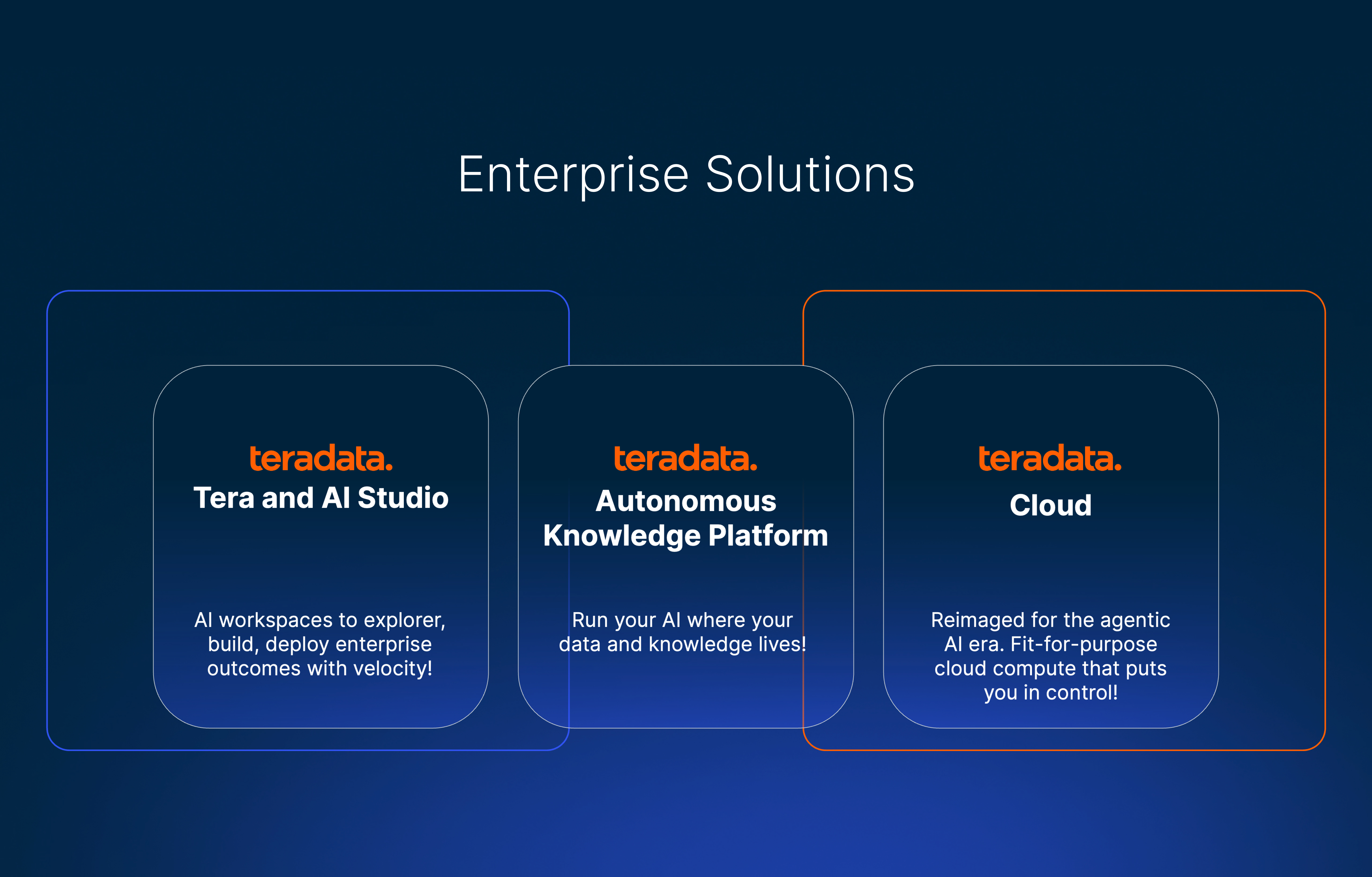
- Can we do this with velocity? We solve for this with Tera, our agentic AI workspace, and AI Studio to focus on agentic AI outcomes.
- Can we serve AI where data and knowledge are, instead of the other way around? We solve for this with our focus on fabric, factory, and sovereign deployments.
- Can we do this without breaking the bank with unbounded consumption bills? We solve for this with Teradata Cloud and a focus on fixed pricing alongside intelligent workload management.
Ecosystem accelerators (agents, unstructured, insight, memory)
Autonomous systems don’t stop at answers—they act. To operate at enterprise scale, teams need a way to design, govern, and run agents, and to turn all enterprise content into reusable knowledge.
With Karini.ai, we add a visual, no-code workflow model that complements Teradata’s pro-code agent capabilities—helping enterprises build repeatable, governed agentic systems embedded in business processes.
Our ecosystem also includes Unstructured to transform complex enterprise content into AI-ready data that lands in Teradata’s Enterprise Vector Store.
WisdomAI provides agentic BI that reasons across enterprise schemas to deliver answers and alerts.
Pinecone extends AI Studio alongside Teradata's native Enterprise Vector Store. Where Teradata handles structured and unstructured data for analytics and batch processing workloads, Pinecone adds a low-latency elastic vector store for operational and real-time agentic needs, all under a single unified architecture.
Our integration with Wisdom and Pinecone is also being designed to deliver enterprise-grade context to AI agents.
An ecosystem with a point of view
What matters most isn’t the number of partners—it’s how intentionally they fit together:
- Design and govern agents
- Extract knowledge from enterprise content
- Generate and improve context continuously
- Generate insight continuously (not only on request)
- Run memory at application speed
Together, these integrations help turn AI from experiments into an autonomous knowledge system—agents that act, knowledge activated across content types, insight delivered in the flow of work, and memory that runs at application speed.
With the platform and ecosystem in place, the focus shifts to what customers can achieve.
What this enables: Enterprise knowledge that’s always activated
The Autonomous Knowledge Platform drives three outcomes:
- Faster time to insight—and action: Reduce friction in preparation and orchestration so teams move quickly from “What happened?” to “What should we do next?”
- Integrated, governed intelligence: Build AI and agents on trusted data—grounded in semantics, lineage, and policy—so outputs are accurate and auditable.
- Operational excellence at scale: Spend less effort on stitching tools and maintaining pipelines—and more on production-grade AI applications, decisioning, and agent workflows.
A platform built for the agent era
Agents don’t sleep—and they generate far more queries than human users. That demands a platform that scales concurrency, performance, and governance without fragmenting architectures or blowing up costs. Teradata’s AI Studio stack is built for this always-on reality: a unified workspace that brings together Tera, AgentStack (including Enterprise MCP), ModelOps, and vector workflows in one governed experience. It helps teams connect agents to trusted enterprise context, operationalize them with lifecycle controls, and scale execution without stitching together disconnected tools.
In my next post, I’ll unpack what it takes to run effectively in an always-on, agent-driven reality. Specifically, I’ll cover how active and elastic compute; high-performance open table format (OTF) data access; and base and flex unit pricing work together to keep performance consistent and economics predictable as demand fluctuates.