
In the first post of this series, I outlined why autonomous knowledge requires more than models—it requires governed enterprise context, agentic execution, and scalable compute. In my second post, I covered what it takes to operate in an always-on, agent-driven reality with active and elastic compute; agentic workload management; high-performance open table format (OTF); and base and flex unit pricing.
Next is execution. How do teams move from experimentation to durable, governed production? Too often the toolchain is fragmented—separate surfaces for notebooks, model management, vector workflows, and agent orchestration.
The answer isn’t more tools—it’s less friction: one environment where teams turn trusted enterprise data into predictive, generative, and agentic outcomes, with governance and operational rigor built in.
Tera: The interaction layer for outcomes
Tera is the agentic AI workspace for interacting with data and AI agents in natural language, backed by enterprise-grade agent execution. Every interaction is grounded in governed enterprise context, so results are both useful and trusted.
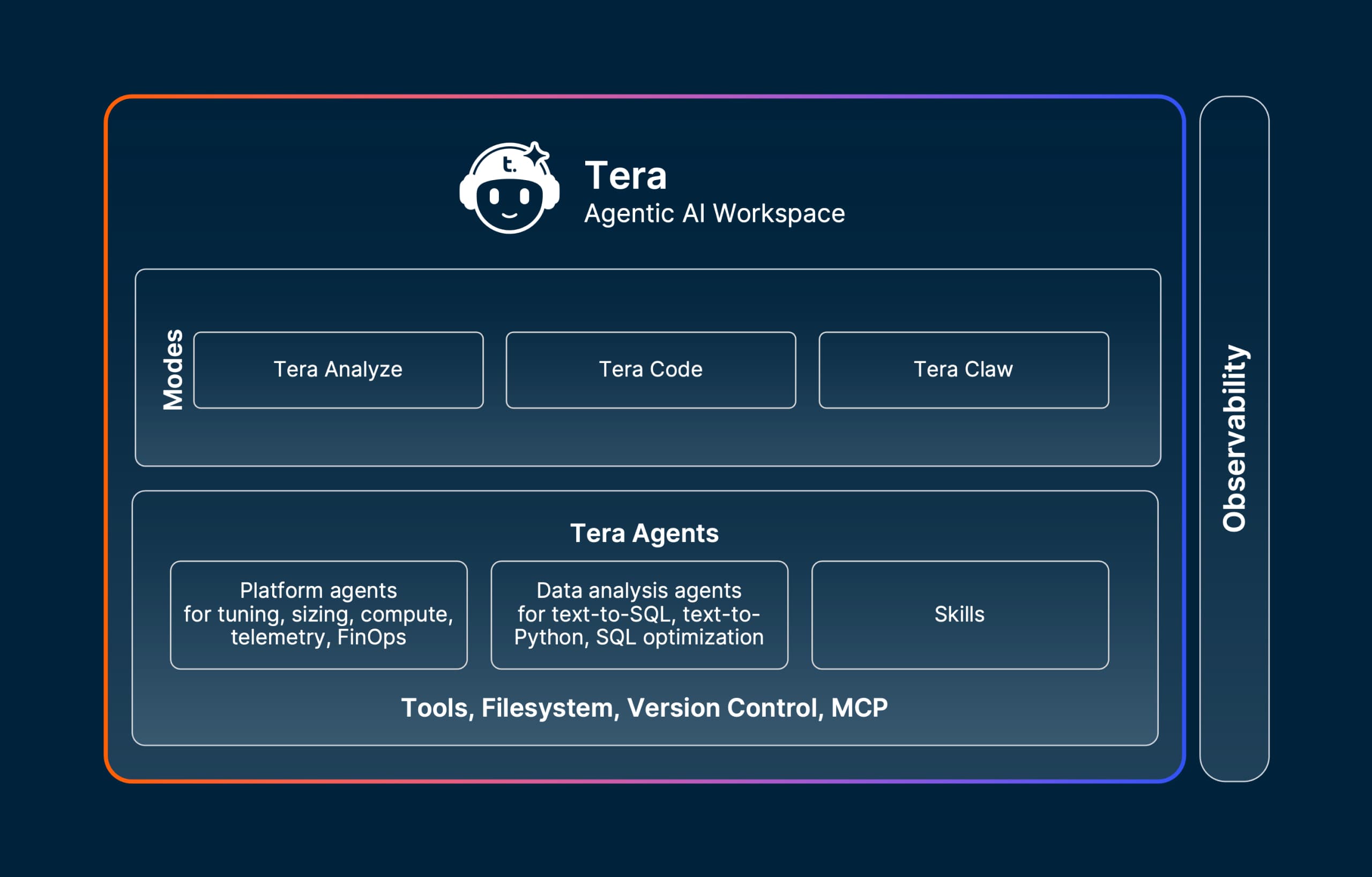
Rather than navigating tools, writing code, or stitching together workflows, users work through Tera to move from question to outcome in a single experience. Tera organizes work into three modes that reflect how teams actually operate—analyzing data, building solutions, and running workflows:
- Tera Analyze provides a conversational interface for data analysis. Grounded in Teradata’s enterprise data foundation, it turns business questions into governed insights that teams can trust and act on—without requiring SQL or technical expertise.
- Tera Code supports developers and technical users by generating, optimizing, and deploying code with awareness of the enterprise environment. It helps teams move faster while maintaining consistency with platform standards and best practices.
- Tera Claw enables autonomous agent teams to run tasks continuously, coordinating multistep workflows to achieve a defined goal with minimal manual intervention.
Together, these modes span the full spectrum from guided exploration to autonomous execution—within a single, governed experience.
Tera agents
Tera delivers a set of agents and skills across these modes. One important group: built-in platform agents that automate workload execution at scale. These platform agents operate in the background to continuously monitor, tune, and optimize system performance and cost.
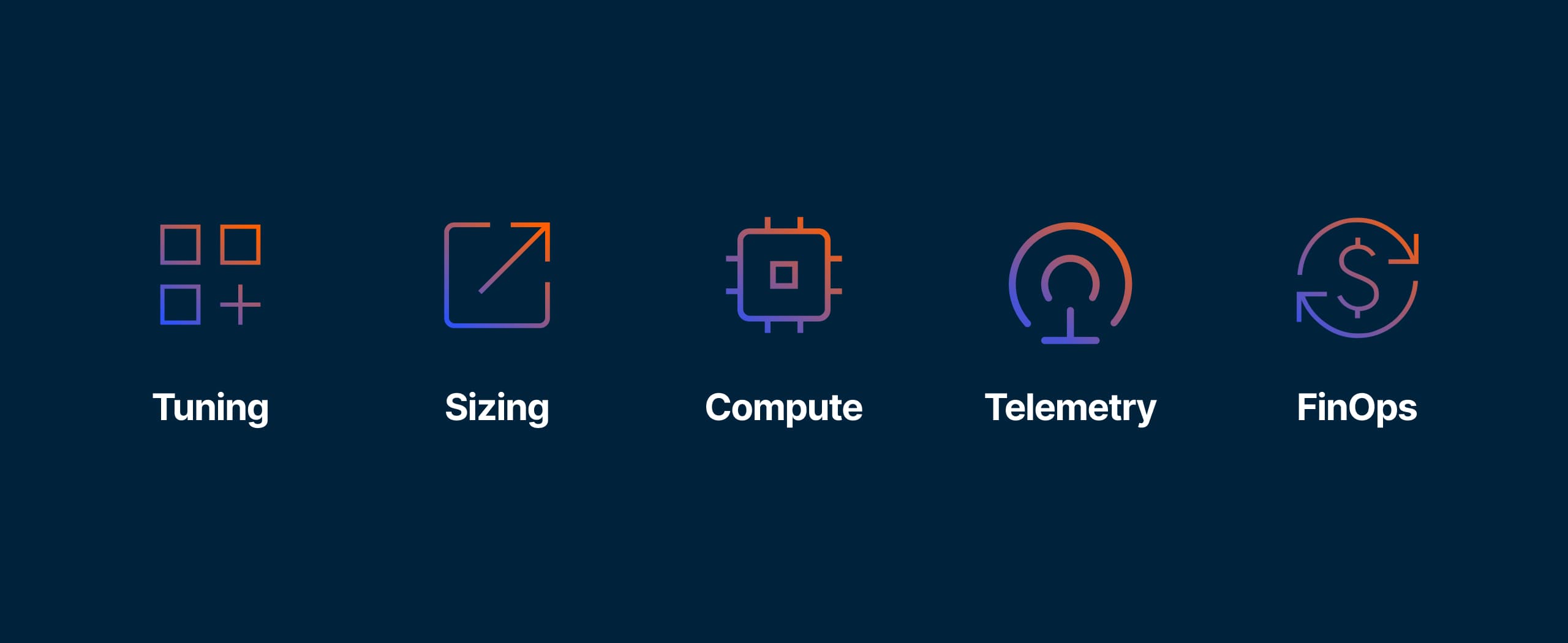
For example, when workloads change, a sizing agent adjusts compute resources to meet performance requirements without overprovisioning. A telemetry agent continuously reads system signals—from query logs to runtime metrics—to understand how the platform is behaving in real time. Building on that, a FinOps agent analyzes usage patterns and flags inefficiencies early, helping teams stay ahead of cost overruns.
At the same time, a tuning agent improves performance by optimizing queries, workload routing, and execution parameters, while a compute agent manages provisioning, concurrency, and execution placement to keep workloads running smoothly at scale.
These platform agents are examples of how Tera extends beyond interaction into continuous execution. They help shift the platform from something teams manage manually to something that continuously optimizes itself—reducing operational overhead while improving performance and cost control.
AI Studio: Where creators build, activate, and manage AI outcomes
Teradata AI Studio is where teams build, activate, and manage AI outcomes end to end—from exploration to production—across analytics and machine learning (ML), generative AI, agents, vectors, and governance. Because it’s part of the Autonomous Knowledge Platform, it’s grounded in trusted enterprise context from day one.
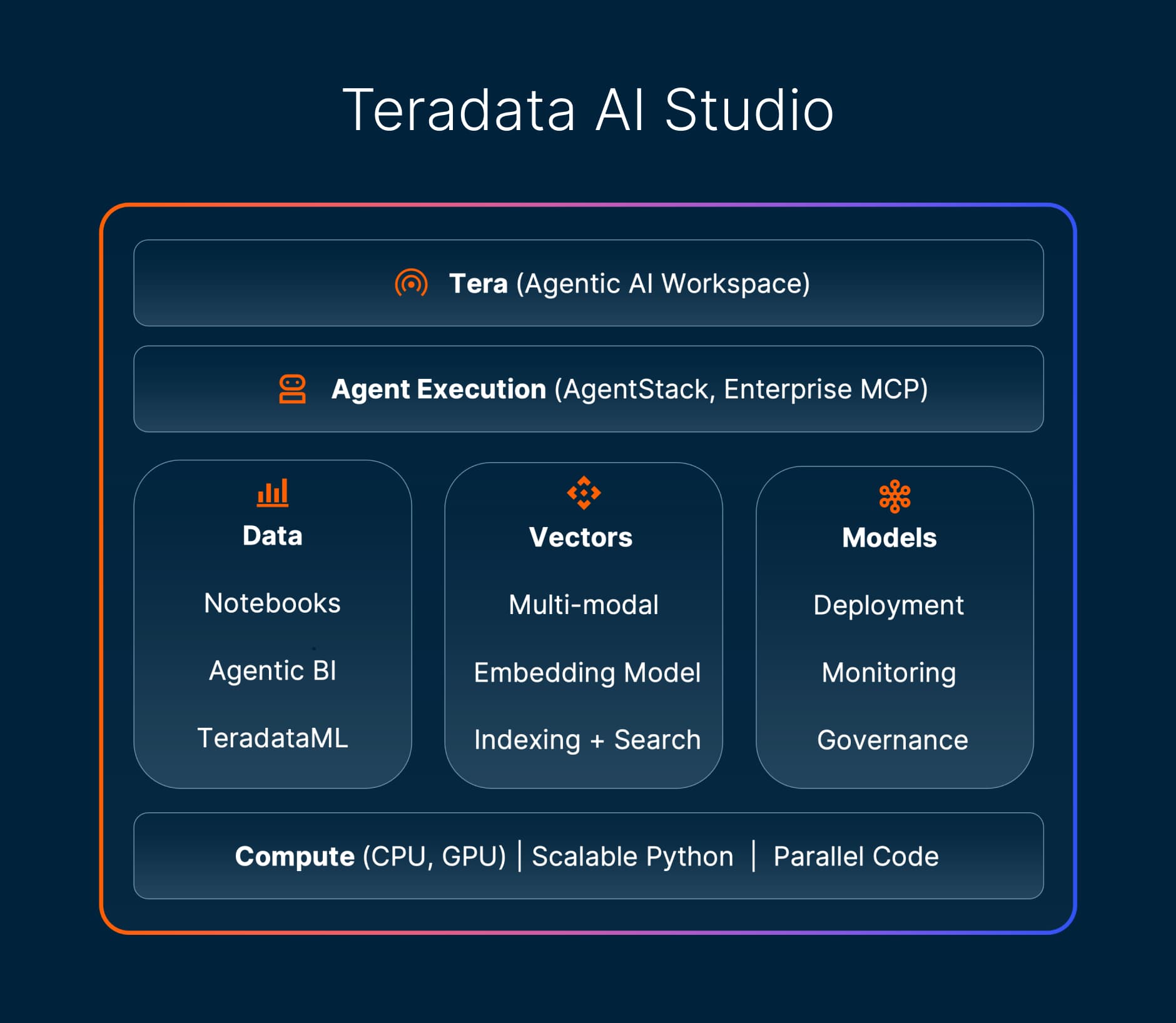
AI Studio brings seven capabilities into one experience:
- Tera: Agentic AI workspace with Tera Analyze, Tera Code, and Tera Claw
- Analytics (TeradataML and notebooks)
- Agents with AgentStack (Enterprise MCP, AgentBuilder, AgentEngine, AgentOps)
- Models with ModelOps lifecycle management
- Vectors via the Enterprise Vector Store (RAG and hybrid search workflows)
- Elastic Python Compute for modern open-source libraries
- Accelerated compute (CPU/GPU) for modern AI performance
Why Tera and AI Studio matter: Turning AI spend into measurable returns
AI Studio shortens the distance between an AI idea and an operational outcome:
- Faster time to value: Standardize the path from exploration to deployment so high-value use cases reach production faster
- Trusted operations by design: Governance and ModelOps are built into the workflow to help ensure deployments are monitored, controlled, and compliant
- Less tool sprawl and better economics: Reduce duplication and bring AI development closer to governed data—improving performance and controlling costs as workloads scale
What teams can deliver with Tera and AI Studio—starting now
Tera and AI Studio are built for teams who create outcomes—data scientists, AI engineers, developers, and analytics teams. In one environment, they can build and operationalize RAG and hybrid search workflows, develop and deploy production-grade agents, and run end-to-end AI/ML pipelines—with enterprise governance and scale.
The next decade of enterprise software will be defined by systems of knowledge—platforms that continuously ground decisions and actions in trusted enterprise context. The Autonomous Knowledge Platform is the foundation. Tera and AI Studio are where teams put that foundation to work.